

12 for 12

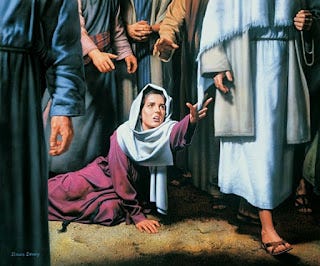
Imagine for a moment that we are linked together, that what happens to one of us can have an effect on all of us. Now look at the connection between the woman and the child in this story.
When Jesus had crossed again in the boat to the other side, a great crowd gathered around him; and he was by the sea. Then one of the leaders of the synagogue named Jairus came and, when he saw him, fell at his feet and begged him repeatedly, “My little daughter is at the point of death. Come and lay your hands on her, so that she may be made well, and live.” So he went with him. And a large crowd followed him and pressed in on him. Now there was a woman who had been suffering from hemorrhages for twelve years. She had endured much under many physicians, and had spent all that she had; and she was no better, but rather grew worse. She had heard about Jesus, and came up behind him in the crowd and touched his cloak, for she said, “If I but touch his clothes, I will be made well.” Immediately her hemorrhage stopped; and she felt in her body that she was healed of her disease. Immediately aware that power had gone forth from him, Jesus turned about in the crowd and said, “Who touched my clothes?” And his disciples said to him, “You see the crowd pressing in on you; how can you say, ‘Who touched me?’” He looked all around to see who had done it. But the woman, knowing what had happened to her, came in fear and trembling, fell down before him, and told him the whole truth. He said to her, “Daughter, your faith has made you well; go in peace, and be healed of your disease.” While he was still speaking, some people came from the leader’s house to say, “Your daughter is dead. Why trouble the teacher any further?” But overhearing what they said, Jesus said to the leader of the synagogue, “Do not fear, only believe.” He allowed no one to follow him except Peter, James, and John, the brother of James. When they came to the house of the leader of the synagogue, he saw a commotion, people weeping and wailing loudly. When he had entered, he said to them, “Why do you make a commotion and weep? The child is not dead but sleeping.” And they laughed at him. Then he put them all outside, and took the child’s father and mother and those who were with him, and went in where the child was. He took her by the hand and said to her, “Talitha cum,” which means, “Little girl, get up!” And immediately the girl got up and began to walk about (she was twelve years of age). At this they were overcome with amazement. He strictly ordered them that no one should know this, and told them to give her something to eat. - Mark 5:21-43
For twelve years, the entire lifetime of the sick child, the woman was suffering from hemorrhages.
It could have been any number of years, but twelve represents the number of tribes and the number of apostles, so it has deeper meaning. Plus, twelve years is a long time to be suffering. It is not a long time to be alive.
So, our perception of the timeframe has implications which are relative. To the woman, it is a lot of suffering. To the girl, it is everything leading up to womanhood. This is the age when she will start bleeding as a sign of reaching maturity, and yet the woman could not stop.
So, we are being asked to imagine they are connected. Both will be healed. One will stop suffering when the other receives a new chance at life.
Jesus didn't want anyone to know about this because he knew we would focus on the miracle and not the connection we all share.
We are one people, children of God, and what affects one, affects all, if we love one another.
Makes you wonder, doesn't it? Why don't we seem to care?
More to come...