

Alive to the World

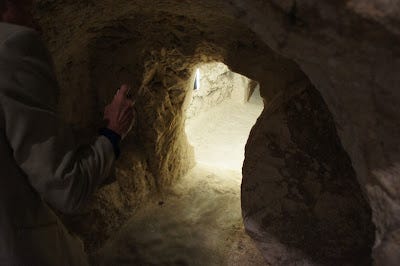
Tomb
What does it mean to be dead to the world?
I discovered that the expression has its roots in religion. William Wordsworth used it to describe the monks and how they lived in "Memorials of a Tour in Italy, 1837" in chapter 14, The Cuckoo at Laverna.
High on the brink of that precipitous rock, Implanted like a Fortress, as in truth It is, a Christian Fortress, garrisoned In faith and hope, and dutiful obedience, By a few Monks, a stern society, Dead to the world and scorning earth-born joys.
The expression came to mind this morning as I read of Jesus' visit to his friend Lazarus, who had died. In the tomb four days, he was literally dead to this world. Jesus brought him back.
Why?
John described it as a way to show the glory of God to those who have faith.
Jesus said to her, "Did I not tell you that if you believed, you would see the glory of God?" - John 11:40
I wonder how Lazarus felt about it. Did he want to come back?
The image John gives is a complex one. He appeals to humanly desires, to avoid grief, to free us from pain, to release us from the prison of our sorrows. But he also shows Lazarus as a prisoner of death.
The dead man came out, his hands and feet bound with strips of cloth, and his face wrapped in a cloth. Jesus said to them, "Unbind him, and let him go." John 11:44
I can read this two ways. I can appreciate the metaphor of prison, trapping us in a place where we cannot move, where our emotion has us frozen. And at the same time, I can see how Wordsworth used the symbolism of death, to show us that we need to let the things that hold us here go and live a life of godliness.
There are many ways I can get myself stuck, frozen, lost. Living in pure faith without fear is so hard to do, and it is not valued. How do we view the monks who set themselves away? Dont we think they have put themselves in a type of prison?
Jesus may not have done Lazarus any favor by bringing him back. In fact, I wonder if John was right about the meaning he attributes to the action. What if Lazarus had a say? What if our free will extends beyond this life? When Jesus called out in a loud voice, he called to Lazarus, not to The Father. He did not say, "Father, bring him back."
When he had said this, he cried with a loud voice, "Lazarus, come out!" John 11:43
By accepting the call from Jesus, his friend, Lazarus, was accepting something far greater. He was giving up his reward to return, for a while.
Why?
By the time Jesus arrived, Mary and Martha had accepted the fact that their brother was gone. Lazarus was at peace, and Jesus would know how glorious that would be for him.
Jesus could have come to mourn with the sisters and leave. But he chose to ask his friend to make a sacrifice and return.
There must be a reason for us to be in this world. It may not just be a testing ground or waiting room for the afterlife. There is something valuable at stake here, now, in the company of others who need us and love us. Jesus called Lazarus back to life in this world, and he may be doing the same for us, when we are lost and self-absorbed. Perhaps we all need to be called back so we can be alive to the world, and make the most of the time we have here.