

Break the Silence

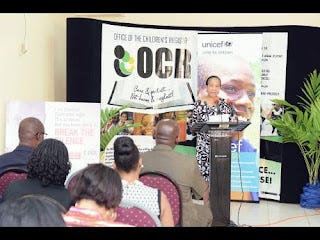
Janet Cupidon-Quallo, UNICEF's child protection specialist,
addressing the launch of the Jamaican Office of the Children's
'Break the Silence' campaign.
Do you know something you aren't telling anyone about?
Would you believe that an island wide survey of adults in Jamaica showed that 50% of adults had knowledge of child abuse, but only 11% reported it?
This week, UNICEF's child protection specialist, Janet Cupidon-Quallo, launched a campaign to save increase that number. The campaign is called,"Break the Silence".
What do you think? If a shepherd has a hundred sheep, and one of them has gone astray, does he not leave the ninety-nine on the mountains and go in search of the one that went astray? And if he finds it, truly I tell you, he rejoices over it more than over the ninety-nine that never went astray. So it is not the will of your Father in heaven that one of these little ones should be lost. - Matthew 18:12-14
The Jamaican Minister of Youth and Culture, Lisa Hanna, said, "In order for us to move forward and to not be alarmed every time something happens, every individual has to take responsibility for child protection. If we are really serious about child protection, then breaking the silence is important."
In today's Gospel reading, Jesus makes this point very clearly. The little ones need to be protected.
It sounds so innocent when we hear of a tiny sheep that has gone astray, but the reality is there are many ways to cause a child to become lost, and we need to be strong enough to break the silence when we see something.
Now, we have all heard stories of people who run to the police accusing parents of abusing their children in one form or another, from the child locked in a hot car to the one spanked in the supermarket. Some say it is justified while others say we go too far, that parents need to discipline their children.
Do we say it is not our issue and walk away?
If we see something and don't report it, because we think we may be jumping to conclusions, so we become part of the problem?
The problem of child abuse is not limited to one small island in the Caribbean. It is pervasive, and it is perverse.
It will be interesting to see how successful Janet is with her "Break the Silence" campaign.
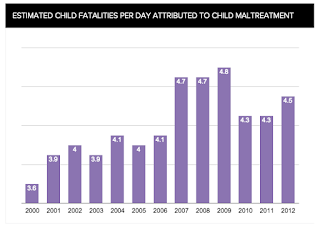
According to ChildHelp, the United States has the largest number of reported cases per year. Does that mean we are better at reporting these cases or can we assume we also fail to report the majority of cases like adults in Jamaica?
"In 2012, state agencies identified an estimated 1,640 children who died as a result of abuse and neglect — between four and five children a day."
The problem of keeping silent is one that has its issues. What about the right to privacy? What about the rights of a parent?
But we need to do something. What is it that makes us abusive? How can we change behavior?
I don't think we like to talk about these things, and that only makes it worse. What we bring into the light we can see and address.
We can leave it all up to God to deal with the abusers, or we can do something now.
As children of God ourselves, we can create a safe place in our churches for children to go, as well as a place to accept and help those who struggle with their abusive past and nature. Many abusers were abused as children. The cycle of abuse needs to stop.
If you haven't been to Safe Church Training, you should go. It covers Safeguarding God's Children and Safeguarding God's People. Beginning this summer, the Diocese of New York is even offering the course online.
Can we change behavior?
Maybe not, but we can be aware of the signs of abuse and the things we can do to make our sacred places safer. Maybe we can keep one sheep from being lost.
More to come...