

Childlike Aspirations

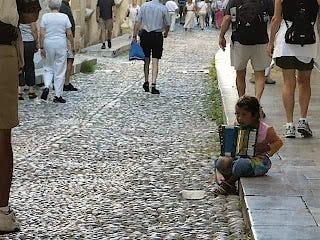
Begging Girl in Rhodes
How can we be like children?
He called a child, whom he put among them, and said, 'Truly I tell you, unless you change and become like children, you will never enter the kingdom of heaven. Whoever becomes humble like this child is the greatest in the kingdom of heaven. - Matthew 18:2-4
In today's reading, Matthew tells us that Jesus gave his disciples a recipe, to be humble like a child.
But what it is a recipe for? Is it the key to salvation? When Jesus refers to the Kingdom of Heaven, what does he mean?
He tells them that welcoming one of these children in his name is welcoming him. Then he goes on to make a threat.
If any of you put a stumbling block before one of these little ones who believe in me, it would be better for you if a great millstone were fastened around your neck and you were drowned in the depth of the sea. - Matthew 18:6
This is not a pleasant thought, and I am not sure what he is saying. Should we let our children do whatever they please or protect them from all obstacles? Is this really about children, or is he giving them a cryptic, dualistic message?
What follows is a stern warning. If your hand causes you to sin, cut it off!
For someone we like to see as a peacemaker, a healer, a teacher, an example of how we should live our lives, what do we take away from this harsh command to rid ourselves of the evil among us?
If you sometimes have difficulty wondering what Jesus would do, welcome to the club. What appears at first glance to be clear wisdom, often requires deep thought and reflection.
What do you think? If a shepherd has a hundred sheep, and one of them has gone astray, does he not leave the ninety-nine on the mountains and go in search of the one that went astray? And if he finds it, truly I tell you, he rejoices over it more than over the ninety-nine that never went astray. So it is not the will of your Father in heaven that one of these little ones should be lost. - Matthew 18:12-14
The image of the shepherd leaving his flock to find the lost sheep has become a universal image of Jesus, and through Jesus, God. Whether you believe the two are one or not, the template is one that works in the framework of WWJD? thinking.
I am thinking, though, that following Jesus is not what Jesus was commanding us to do as much as coming to God with our arms open wide like a child. The lost sheep is in serious danger and will most likely die without the protection and care of the shepherd. The same is true of the child and its parents.
Everyday I read or hear of some child who is lost, abused, strangled, plunged to his death, raped, tortured, exorcized, beaten, the list goes on, and I am sure it was not much different in the days when Jesus taught his followers.
This is an evil and horrific world we live in, and though we are never alone, God does not stop us from doing what we choose to do, good or evil.
So, how do we decide what is right and what we should do?
I don't think it is very helpful to rely on our interpretation of what Jesus would do, though it is an appealing thought, that there is a recipe in his words and actions that can help us with every situation. There isn't. And our interpretation may be totally flawed. It is a life-long learning experience at best, so we need another way to apply our faith to our actions.
The scary thing about having childlike aspirations is that children make mistakes, wander off, need constant attention.
When we see adults act that way, we want to lock them up for their own protection.
So, when Jesus says to become like children, what does that mean?
Children let their emotions out. They cry when hurt, they get angry when wronged, they run or hide when scared. It is the fear that adults and others put into them, playing on their emotions, that causes them to keep secrets and not tell of bad things others do.
If we become like children, say and do what we truly feel, when we feel it, we might be locked up, like those suffering with dementia. Perhaps our efforts to civilize and domesticate our behavior is not all that beneficial.
I, for one, seek to be more like a child, and I know that means people will think me crazy, will misinterpret or misunderstand what I say, will wonder if I need medication. But with the possibility we all face of fewer days ahead than behind, why pretend everything is fine, when it isn't? And why fail to say the things I want to say or do the things I feel I need to do. for fear of hurting someone's feelings?
I aspire to be childlike to be free of self-imposed assumptions, restrictions and preconceived notions of the world around me. And that may not please everyone.
What about you? Are you ready to come out and play?