

Demons

There was a time when we had a much simpler view of the world. There was good and evil, and we were either beneficiaries or victims of one or the other.
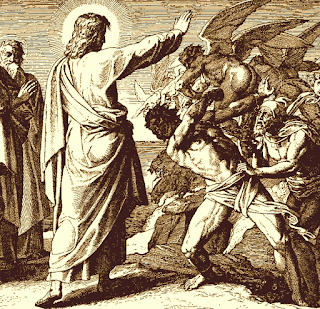
He went down to Capernaum, a city in Galilee, and was teaching them on the sabbath. They were astounded at his teaching, because he spoke with authority. In the synagogue there was a man who had the spirit of an unclean demon, and he cried out with a loud voice, ‘Let us alone! What have you to do with us, Jesus of Nazareth? Have you come to destroy us? I know who you are, the Holy One of God.’ But Jesus rebuked him, saying, ‘Be silent, and come out of him!’ When the demon had thrown him down before them, he came out of him without having done him any harm. They were all amazed and kept saying to one another, ‘What kind of utterance is this? For with authority and power he commands the unclean spirits, and out they come!’ And a report about him began to reach every place in the region. - Luke 4:31-37
When we say that someone is battling his demons, we mean he is struggling with something that has a grip on him, like addiction or mental illness.
In the Gospels, the subject of demons comes up a lot, and there has been much written about the thinking at the time, and what Jesus may have believed or thought about them. In his treatise, "Did Jesus Believe in Demons", A. Wakefield Slaten, PH.D. Professor of Biblical History and Literature, The Young Men's Christian Association College in Chicago points out that demons, evil spirits, and unclean spirits are mentioned 70 times in the four Gospels, and that doesn't include mention of Spirit or Holy Spirit.
And the historian Josephus talks about exorcists like Eleazar who pulled demons out from their hosts with the use of a magic ring.
If demons actually exist and possess our bodies, turning us into slaves, it would change everything about how we treat one another, wouldn't it?
After all, who could be responsible for what they did, if demonic possession was in play?
Maybe that is the challenge Jesus is giving us here. Think not of the person when you see his actions, but instead think of the forces at play driving him to do them.
What that approach does is force us to think of a cause for each effect. What can we do about what caused this? That is the question we should ask.
But it is so much easier to just see the person as evil, isn't it?
More to come...