

Divergence

Do you ever think you have it all together but at the last minute you chicken out?
When they came to the crowd, a man came to him, knelt before him, and said, "Lord, have mercy on my son, for he is an epileptic and he suffers terribly; he often falls into the fire and often into the water. And I brought him to your disciples, but they could not cure him." Jesus answered, "You faithless and perverse generation, how much longer must I be with you? How much longer must I put up with you? Bring him here to me." And Jesus rebuked the demon, and it came out of him, and the boy was cured instantly. Then the disciples came to Jesus privately and said, "Why could we not cast it out?" He said to them, "Because of your little faith. For truly I tell you, if you have faith the size of a mustard seed, you will say to this mountain, 'Move from here to there,' and it will move; and nothing will be impossible for you." - Matthew 17:14-21
Sometimes we overthink a situation.
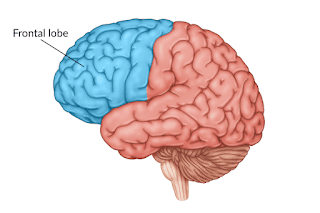
There is a part of the brain that controls reason. It is called the frontal lobe, and it sits right up there in the captain's seat making decisions about the course we are taking or the choice we are making.
It gets in the way of faith sometimes.
Faith propels us forward when the reasonable thing to do is hold back. And it doesn't take a lot to start the spiral that unravels our confidence once we begin to hesitate.
After all, what is faith if not confidence?
Jesus became frustrated with his disciples because they didn't have enough faith, but maybe it was something else. Maybe they didn't know how to effectively employ frontal lobes.
The frontal lobe helps us with divergent thinking, which is exactly what we need when confronted with a conflict between reason and reality. When Jesus posed a situation that put the disciples in conflict, they reconciled reason with reality by acting in a way that made the reality fit their preconceptions.
Come to think of it, we all do that. We look at a problem and see only one way to solve it, or worse, we see no way to solve it.
So, when presented with the possibility of doing something, we automatically reject it. Any attempt is, at best, half-hearted.
So, the disciples couldn't wrap their heads around the idea that their words alone could heal.
Who could blame them?
It takes something special to ignore what we believe we know and go with what we know we believe.
More to come...