

Double Image

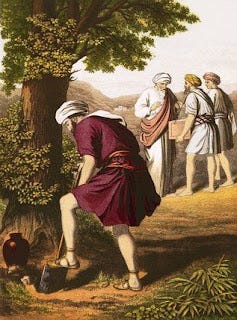
Have you ever wondered how two people could witness the exact same scenario and walk away with two different interpretations of what they saw?
"For it is as if a man, going on a journey, summoned his slaves and entrusted his property to them; to one he gave five talents, to another two, to another one, to each according to his ability. Then he went away. The one who had received the five talents went off at once and traded with them, and made five more talents. In the same way, the one who had the two talents made two more talents. But the one who had received the one talent went off and dug a hole in the ground and hid his master's money. After a long time the master of those slaves came and settled accounts with them. Then the one who had received the five talents came forward, bringing five more talents, saying, "Master, you handed over to me five talents; see, I have made five more talents.' His master said to him, "Well done, good and trustworthy slave; you have been trustworthy in a few things, I will put you in charge of many things; enter into the joy of your master.' And the one with the two talents also came forward, saying, "Master, you handed over to me two talents; see, I have made two more talents.' His master said to him, "Well done, good and trustworthy slave; you have been trustworthy in a few things, I will put you in charge of many things; enter into the joy of your master.' Then the one who had received the one talent also came forward, saying, "Master, I knew that you were a harsh man, reaping where you did not sow, and gathering where you did not scatter seed; so I was afraid, and I went and hid your talent in the ground. Here you have what is yours.' But his master replied, "You wicked and lazy slave! You knew, did you, that I reap where I did not sow, and gather where I did not scatter? Then you ought to have invested my money with the bankers, and on my return I would have received what was my own with interest. So take the talent from him, and give it to the one with the ten talents. For to all those who have, more will be given, and they will have an abundance; but from those who have nothing, even what they have will be taken away. As for this worthless slave, throw him into the outer darkness, where there will be weeping and gnashing of teeth.' - Matthew 25:14-30
I wonder if Jesus intended it that way.
Did he want us to see God rewarding those who invest their money and talents? Or was he looking to see if we could uncover another message?
What bothers me about the interpretation that focuses on us using our talents is that it makes God out to be ruthless.
If the Master in this parable is supposed to be God, the message is we had better please Him and return to Him the fruits of our labor, or else.
True, people have said that the slave who buried the talent was just being lazy, and there is that interpretation to consider. We should do something with what we are given.
And that is what makes this interpretation so popular, that and our desire to be validated in how we manage our finances.
But Jesus is always telling his disciples and potential followers to give everything away, to offer our wealth to the poor.
So, what gives?
If the third slave had given away the talent to someone who had nothing, the story would have taken on a very different tone.
I think Jesus may have been looking for a heated discussion with this parable, pitting those who saw God as unforgiving and cruel against those who saw their ministry to stand up to tyrants who ruled only for money.
Either interpretation, though, has the potential to get us closer to the truth about ourselves and our interests and focus.
If we want to justify our wealth, we have an interpretation that allows us to do that, and if we want to resist oppression, we can place ourselves in the role of the slave who didn't play along.
In the end, though, we need to ask what our motive is.
Are we looking to love our neighbors as ourselves, or not?
I would have loved to hear what Jesus had to say.
More to come...