

Favored Son

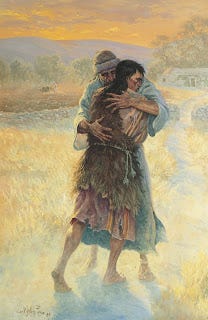
Sometimes we focus on the wrong thing.
All the tax collectors and sinners were coming near to listen to Jesus. And the Pharisees and the scribes were grumbling and saying, "This fellow welcomes sinners and eats with them." So Jesus told them this parable: "There was a man who had two sons. The younger of them said to his father, 'Father, give me the share of the property that will belong to me.' So he divided his property between them. A few days later the younger son gathered all he had and traveled to a distant country, and there he squandered his property in dissolute living. When he had spent everything, a severe famine took place throughout that country, and he began to be in need. So he went and hired himself out to one of the citizens of that country, who sent him to his fields to feed the pigs. He would gladly have filled himself with the pods that the pigs were eating; and no one gave him anything. But when he came to himself he said, 'How many of my father's hired hands have bread enough and to spare, but here I am dying of hunger! I will get up and go to my father, and I will say to him, "Father, I have sinned against heaven and before you; I am no longer worthy to be called your son; treat me like one of your hired hands."' So he set off and went to his father. But while he was still far off, his father saw him and was filled with compassion; he ran and put his arms around him and kissed him. Then the son said to him, 'Father, I have sinned against heaven and before you; I am no longer worthy to be called your son.' But the father said to his slaves, 'Quickly, bring out a robe--the best one--and put it on him; put a ring on his finger and sandals on his feet. And get the fatted calf and kill it, and let us eat and celebrate; for this son of mine was dead and is alive again; he was lost and is found!' And they began to celebrate. "Now his elder son was in the field; and when he came and approached the house, he heard music and dancing. He called one of the slaves and asked what was going on. He replied, 'Your brother has come, and your father has killed the fatted calf, because he has got him back safe and sound.' Then he became angry and refused to go in. His father came out and began to plead with him. But he answered his father, 'Listen! For all these years I have been working like a slave for you, and I have never disobeyed your command; yet you have never given me even a young goat so that I might celebrate with my friends. But when this son of yours came back, who has devoured your property with prostitutes, you killed the fatted calf for him!' Then the father said to him, 'Son, you are always with me, and all that is mine is yours. But we had to celebrate and rejoice, because this brother of yours was dead and has come to life; he was lost and has been found.'" - Luke 15:1-3, 11b-32
This parable story introduces us to three characters, a father and his two sons.
At first it seems to be about the son who rejects his father, takes his inheritance and squanders it.
But then, when the son returns home, and the father rejoices, the story shifts to the other son, the good one, the one who stayed and worked hard for the father.
This is the son Jesus wants us to focus on. He is the one we can relate to the most, if we, like he, feel ignored, unappreciated for all we do.
We don't rejoice in the return of the lost, because we cannot relate to them. To us, they were weak or foolish or possibly even evil.
The father is probably the least understood in the story. He cares deeply about both sons, the one with him and the one who was lost and presumed dead.
Imagine the child you thought dead coming back to life. How would you react?
The good son lives with his feelings about the brother who abandoned the family business, rejected the father and left all the work to him.
That is a lot to forgive, and he is not ready or willing to just let it go.
What the son feels is rejection, and he should feel love. The father loves him dearly and is blessed to have him with him always, but all he sees is the love the father has for his brother who he feels doesn't deserve it.
We don't earn God's love. It is always there.
We are the ones who reject Him. He never rejects us.
So, the story is really about the motives of the son who stayed. Did he do it for love or for something else?
His reaction leads us to think he expected the father to show him favor, and he couldn't recognize that favor when it was there all along.
More to come...