

First Cut

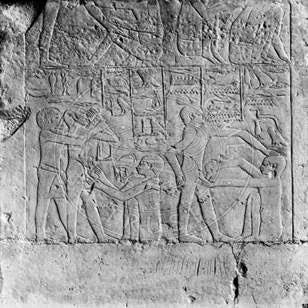
Egyptian Record of Circumcision
While we may still be glowing with Christmas cheer, we have come to the day we commemorate the naming of the baby Jesus.
By that, of course, we mean the brit milah, or Bris.
Throughout your generations every male among you shall be circumcised when he is eight days old, including the slave born in your house and the one bought with your money from any foreigner who is not of your offspring. Both the slave born in your house and the one bought with your money must be circumcised. So shall my covenant be in your flesh an everlasting covenant. Any uncircumcised male who is not circumcised in the flesh of his foreskin shall be cut off from his people; he has broken my covenant.’ - Genesis 17:12-14
We tend to be a bit squeamish about the shedding of the first blood of an eight day old baby boy, but in Jewish tradition, the circumcision is much more than a medical procedure. In fact, it is not viewed that way at all.
The person who kneels down and holds the baby is the sandek. It could be a grandfather, a parent or someone learned in the Torah that the parents choose. In Jesus' time, that may have been Joseph.
The mohel, the one specially trained in such matters, performs the procedure, which happens in three stages.
The first step is to remove the baby's foreskin. Then, the mucous membrane is pulled back to expose the glans. The final step is the metzitzah, or suctioning of the blood from the wound. There are hygienic ways to do that today that didn't exist at the time of Jesus. Back then, these rituals were a lot more personal.
Of course, such a solemn and joyous tradition involves prayers, and the prayers said before and during the ceremony acknowledge the commandment to Abraham and the covenant with God.
Before we go on, it should be noted that the girls are also given their names in ceremonies, but those are done on the first Sabbath after the birth and do not involve surgical procedures.
Now, let's go back to the part about the slaves born in the household and the ones bought with money. Given the intimacy and importance of the ceremony, which back in Abraham's time was performed at puberty, rather than in infancy (don't even think about that, guys), I wonder how it was done for the slaves.
Yes, it is a physical sign, a way to identify who belonged to the community and who didn't, and this is clearly spelled out in the reading from Genesis. But it is also a bond with God as well as with the community.
The Jews weren't the only people who performed it. It is believed the Egyptians were the first, though other cultures adopted it as well. But when it comes to the covenant with God, the relationship between the Jews and their slaves takes on a deeper meaning than we often ascribe to slavery.
Ownership, yes, but more than that. Such an intimate act, surrounded in tradition and meaning, there must have been a very intimate relationship with one's slaves.
As we find ourselves beginning a new year, faced with examples of hatred all around us, I wonder if there is a message in this reading that eludes us.
Welcome, Baby Jesus, into the community. May we learn to accept all people and embrace them with love, remembering how you came into this world to be one with us.
More to come...