

Going Overboard

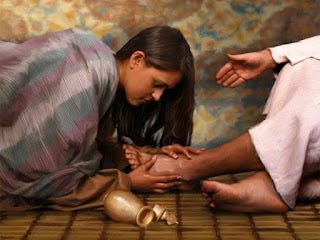
If Mary bought the nard to anoint Jesus for burial, why would she use it now, while he is alive?
Six days before the Passover Jesus came to Bethany, the home of Lazarus, whom he had raised from the dead. There they gave a dinner for him. Martha served, and Lazarus was one of those at the table with him. Mary took a pound of costly perfume made of pure nard, anointed Jesus' feet, and wiped them with her hair. The house was filled with the fragrance of the perfume. But Judas Iscariot, one of his disciples (the one who was about to betray him), said, "Why was this perfume not sold for three hundred denarii and the money given to the poor?" (He said this not because he cared about the poor, but because he was a thief; he kept the common purse and used to steal what was put into it.) Jesus said, "Leave her alone. She bought it so that she might keep it for the day of my burial. You always have the poor with you, but you do not always have me." When the great crowd of the Jews learned that he was there, they came not only because of Jesus but also to see Lazarus, whom he had raised from the dead. So the chief priests planned to put Lazarus to death as well, since it was on account of him that many of the Jews were deserting and were believing in Jesus. - John 12:1-11
We know Mary had a special relationship with Jesus, because she was the one who sat at his feet and listened to him while her sister, Martha, prepared the meal.
She was captivated by him and by his teaching, plus, Jesus raised her brother from the dead.
So perhaps she chose to anoint him now, rather than wait for his death, to let him know how much she appreciated him.
But John uses images in his Gospel to point us to something else, and this could be a sign of what is to come, with Jesus washing the feet of his disciples at the Last Supper.
The action, though, is all Mary. She chose to take this moment to show her love of Jesus in such a touching and meaningful way.
I think John spoils the moment by bringing Judas into it, claiming to be concerned about the poor.
It shifts the attention of the reader from an act of love and thanks to a comparison of the use of wealth.
What would you do, if Jesus was among you and had brought life back to someone you loved?
I think you might go a bit overboard in thanking him.
More to come...