

Interference

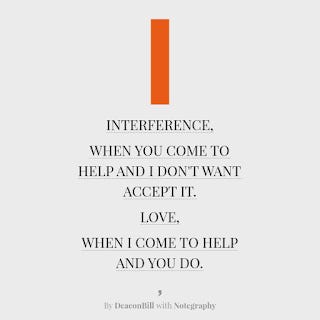
When I was young, I looked up to my dad. He was smart, strong and he wanted the best for us, his children. For the most part, he let us do our school work, make our decisions, and he didn't interfere.
But occasionally he would get involved, and when he did, it would stop us cold in fear.
Fear came over all their neighbors, and all these things were talked about throughout the entire hill country of Judea. All who heard them pondered them and said, 'What then will this child become?' For, indeed, the hand of the Lord was with him. - Luke 1:65-66
In today's readings, as in my childhood, we see an example of what happens when our father chooses to involve himself in our lives. We become afraid.
What does he have in mind? What is his plan? Why now?
This is the season of Advent, the time when we prepare ourselves for the coming of the infant Jesus. We do so without fear, but if we really thought about what this child represents, we might change our minds about that.
We say that God so loved the world that he sent his son, but we could also say that Gd, our Father, decided it was time to interfere. We needed help to get on the right track.
No wonder the people were afraid when they heard the story of Zechariah, unable to speak while Elizabeth carried their child, suddenly receiving his voice when he accepted God's interference and will.
This was not a hasty decision to make such a radical change in the relationship of God to man. We had to be close to disaster, headed down the wrong path, out of control, for God to interfere. But how could He do that without taking away our free will?
He did it through a child, a babe.
There were many who would not accept such a radical step, many who would want that child sent back. Many would reject the very thought that it could be possible for God to walk among us as one of us, and many still do today.
Over the remaining days until Christmas, we will occupy our lives with shopping and preparing for family and friends to visit and celebrate together. We will be joyous and thankful. We will not look at the day of the child's birth as something to fear, and I guess that is a good thing. But we might be missing the significance of this event we remember with joy.
When we study together as members of all faiths, we open our eyes to the meanings we share and the meanings we keep. We delicately walk the line of common faith, remembering that we could easily offend those who do not believe as we do.
But what we share among us is the knowledge that despite our free will, granted to us by God, we have a father who is very involved in our lives, as evidenced by all the stories of al the good books we turn to for guidance.
He interferes a lot. He comes into our room uninvited and seeks us out, draws us into the light and shows us what we are doing wrong and what we are doing right.
So, we come to respect the many ways we remember that, and we strive to be good examples of our faith. As Christians anticipating the day of Christ's birth, we need to recall Zechariah's struggle to understand, and his acceptance of God's will.
We need to see this Advent as a period of overcoming the fear of God in our lives, and to welcome Him in.
He is with us always, to be more than the judge of us, more than the one we fear.
But as we prepare to welcome him, we need to accept the responsibility for care and nurturing, as we would if we were the parents and God was the child. In that way, we come to understand how God sees us and how we should see ourselves.
More to come...