

Jagged Edges

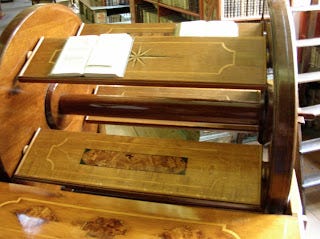
I have a thing about jagged edges.
When I worked at Doubleday Book & Music Clubs, one of the perks for the staff was the Book Sale. Every so often, I forget if it was weekly or not, a day was set aside to offer Book Club Editions of current and past books for 25 cents each. It was an amazing deal. I stocked up often, though I have to admit, I could never read everything I bought.
One of the things that bothered me, though, about these books was that the pages were not cut evenly. The paper quality was not as nice as the book store editions the publishers put out, and the unevenness of the page edges gave the book a rough and jagged appearance. But it was a quarter!
Once I opened the book, however, the printed pages were just as nice as the original. Unlike the pages themselves, the text was justified.
In today's reading, Paul talks about us being justified, and I can't help but think about the books when I read it.
Much more surely then, now that we have been justified by his blood, will we be saved through him from the wrath of God. - Romans 5:9
Justified, in a theological sense, means "set right, or made righteous." I guess that could be the same thing as being properly aligned, as text in a paragraph, but Paul's realignment message is troubling. It sounds like we were doomed to God's wrath and judgment before Jesus died for us.
We read this, we say it aloud in church, we sing it, but do we understand it?
It isn't an easy thing to explain to non-believers, is it? For one, we need to understand it ourselves.
I tend to forget that at one point in time, God was a figure to be feared, and not just in the sense of being worshipped and glorified, but someone or something capable of inflicting terrible punishment on us if we crossed Him. The stories in The Bible are written from that perspective, so it is easy to think of God as patient but angry most of the time. It was the view I had growing up. You just didn't cross God. If you did, there would be Hell to pay, literally. And life on earth might not be so pleasant either.
But Jesus gave us a different view of God in his parables. The loving father waiting for his sone to return, running to him when he saw him, giving him more than he deserved. In that father's eyes, there was no wrath, no anger, just thankfulness and joy. That father was more an image of what I aspire to be than the vengeful ogre waiting for me to screw up.
If Paul is talking about being set straight to see that God, then maybe the term justification can make some sense. But what about the blood?
Jesus died for our sins.
Or, in other words, his blood was shed so that we may live. We may hear these expressions a lot, but when asked what they mean, how many answers do we get?
Another way to look at it is how does the resurrection play into this?
These are tough questions, I admit. They are the types of questions we deal with in our Education for Ministry course. Since the language of Scripture is rich with history, culture and tradition, calling on earlier Scriptures and symbolism to teach, to inform and to become a part of the lives of the Children of God, we try to gain a deeper understanding of the meaning for us, by reflecting on these perspectives.
That all may sound like a way around answering the question that lies at the heart of our faith - what does it all mean? But I have learned a great deal about my own beliefs by sharing with others in an unthreatening and loving environment, where anything can be asked without judgment.
For me, that is part of the process of realignment, the turning around and setting straight of my purpose and direction, so that I can see the Father that Jesus wants me to see.
I remember a memorial acclamation of my youth in the Catholic Church:
Dying you destroyed our death, rising you restored our life. Lord Jesus, come in glory.
The part about destroying our death is what I believe the term justification is all about. But his death alone isn't enough, is it? It is by rising again, that we believe and see that there truly is life everlasting. So, if we are set righteous in Christ, and we don't need to prove ourselves to be in God's good graces, what are we doing with that grace?
Like those books I mentioned earlier, we all have a story within us that needs to be heard or read. Setting the pages right doesn't tell that story. It only takes away the distraction of the jagged edges.
No matter how perfect we make the book, it can't serve its purpose with out us doing something. What if the real wrath of God is that look of disappointment a parent gives when we fail to do what we promise, like waste the life we've been given?