

Labeled

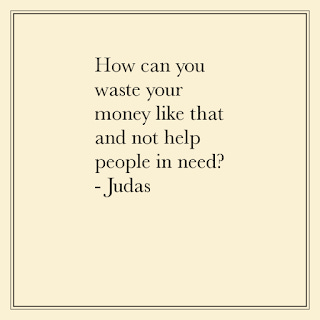
Was Judas a thief?
Six days before the Passover Jesus came to Bethany, the home of Lazarus, whom he had raised from the dead. There they gave a dinner for him. Martha served, and Lazarus was one of those at the table with him. Mary took a pound of costly perfume made of pure nard, anointed Jesus' feet, and wiped them with her hair. The house was filled with the fragrance of the perfume. But Judas Iscariot, one of his disciples (the one who was about to betray him), said, "Why was this perfume not sold for three hundred denarii and the money given to the poor?" (He said this not because he cared about the poor, but because he was a thief; he kept the common purse and used to steal what was put into it.) Jesus said, "Leave her alone. She bought it so that she might keep it for the day of my burial. You always have the poor with you, but you do not always have me." - John 12:1-8
All four Gospels tell a version of this story, and they tell it in different ways. In John's version, the woman anointing Jesus is Mary, and she is doing so in thanksgiving for her brother, Lazarus', life. Remember that Jesus raised Lazarus from the dead.
The focus of the story, though, is not Mary and her act of thanksgiving, but Judas, who takes exception and is labeled a thief by the author, John.
I have always had trouble with the idea that Jesus would give a thief control of the purse. While that may be a great gesture of trust for someone who is redeemed, it wouldn't sit well with the others who were probably not as trusting or trustworthy themselves.
So, what is going on here?
I think Judas has become skeptical, having heard example after example of Jesus calling out others for hypocrisy, he has latched onto this act as something he could use to challenge Jesus. Are you being a hypocrite by letting her adorn you with perfume while the people you care about are hungry?
This is actually a valid question, one we may face in our personal ministries.
How Jesus responds is also quite telling, but we may find that too to be troublesome, since he talks about the poor being always with us. It sounds as though he is putting himself above the poor, which seems to support Judas' point.
But Mary bought the perfume with the intent of using it on Jesus when he dies, and she decides to give it to him now, while he is alive and with her. She doesn't wait, but shares it now.
It is an act of love.
So the point may be all about love and sharing while we can with those we care about. Don't wait until it is too late for them to know how we feel.
She will be able to use her money to feed the poor after Jesus is gone, but she chose to give him what she planned to anoint him with at death now, when it matters more.
Now we don't know how Judas reacted to what Jesus said, but he may not have been convinced that Jesus had not lost sight of his ministry. He was judging Jesus, and that judgment may have stuck with him to the end.
Don't we do the same? When we see someone with great wealth lavishing it on friends and loved ones, don't we want to say that money could help so many?
That doesn't make us thieves who want the money for ourselves, but it does make us judges, and we may not have all the facts.
When we think of Judas we should think of ourselves and how we compare our generosity to those of others. Are we judging based on what we project on them, or do we know for certain they are being hypocritical, greedy or selfish?
Labels are easy. Understanding and compassion are hard.
More to come...