

Legacy Statement

Sometimes we need to witness something firsthand before we can truly believe it.
When it was evening on that day, the first day of the week, and the doors of the house where the disciples had met were locked for fear of the Jews, Jesus came and stood among them and said, "Peace be with you." After he said this, he showed them his hands and his side. Then the disciples rejoiced when they saw the Lord. Jesus said to them again, "Peace be with you. As the Father has sent me, so I send you." When he had said this, he breathed on them and said to them, "Receive the Holy Spirit. If you forgive the sins of any, they are forgiven them; if you retain the sins of any, they are retained." But Thomas (who was called the Twin), one of the twelve, was not with them when Jesus came. So the other disciples told him, "We have seen the Lord." But he said to them, "Unless I see the mark of the nails in his hands, and put my finger in the mark of the nails and my hand in his side, I will not believe." A week later his disciples were again in the house, and Thomas was with them. Although the doors were shut, Jesus came and stood among them and said, "Peace be with you." Then he said to Thomas, "Put your finger here and see my hands. Reach out your hand and put it in my side. Do not doubt but believe." Thomas answered him, "My Lord and my God!" Jesus said to him, "Have you believed because you have seen me? Blessed are those who have not seen and yet have come to believe." Now Jesus did many other signs in the presence of his disciples, which are not written in this book. But these are written so that you may come to believe that Jesus is the Messiah, the Son of God, and that through believing you may have life in his name. - John 20:19-31
Thomas gets a bad rap.
We remember him as the one who doubted, but in doing that, in labeling him, we ignore the fact that all the apostles doubted what they heard about Jesus.
None of them believed what the women told them they saw.
Why aren't they remembered as doubting apostles as well?
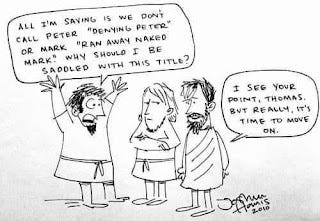
I added the image of the meme that was posted by Episcopal Church Memes about this, where Thomas is complaining. It made me think about how we behave when we feel unjustly singled out.
We may think, "Others do this, why are you picking on me?"
But the question is, would we know Thomas at all if we didn't have this account from John's Gospel?
In other words, is it better to be remembered for something you are not proud of than to be forgotten?
When we finally take the time to sit down and think about the legacy we leave, what will we focus on?
What will others remember us for?
Chances are they will remember the good things we did for others, rather than the things we failed at or were wrong about.
But we still have time to build our legacy statement. We can go out and be the person we want to be remembered as.
And hopefully, someone won't write about the one thing we are least proud of, like John did to Thomas.
More to come...