

Man of Bone?

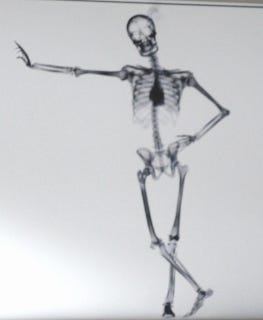
Man of Bone?
I had an interesting conversation earlier this year with an orthopedic surgeon, Dr. Marvin Gilbert. He explained how amazing the human body truly is, and he described it in a way I had never imagined before.
He talked about bones, a topic about which he has amassed a great deal of knowledge in over 30 years of practical experience as a surgeon. He said that metal is not as strong as bone.
Yes, I found that hard to believe myself, but he went on to explain that bones respond to stress differently than metals do. As we exert pressure on our limbs, by running, walking, or playing, the body reacts to the added stresses on it and begins working to strengthen and build up the bones.
Imagine that!
Of course, we can overdo it, not giving enough resting time between stresses to give the body a chance to work, but it seems miraculous to me that within each of us is a mechanism to not only repair, but improve the equipment we have.
When we couple that knowledge with the fact that repetitive stresses on metal can cause it to fail, we can begin to understand that with all the advances of medicine, the best we can do is provide a temporary substitute for the real thing.
Bone is stronger than steel? How can that be? Who ever heard of a Man of Bone?
All right, so maybe this isn't a big surprise to you. Remember, I tend to come to these realizations like a tortoise to the finish line in a ridiculous race, but I like thinking that in some ways, I am like Superman, stronger than I thought. I like the control it gives me to become more than I am.
I also like the idea that with all we have gained from the study of us, we haven't yet improved on the overall design. And that doesn't mean we won't come closer.
Throughout my formative years, which hopefully haven't ended, I was and remain a student of science. I am that rare breed that sees no conflict, beyond my own limited ability to grasp the depth and width of this wonderful creation in which I live and breathe, between a belief in God and an utter fascination for and respect for the need to form hypotheses, test them, make observations and draw conclusions, only to reach a higher plateau gaining a new vantage point for new hypotheses.
In other words, what if God wants us to know all we can discover about ourselves and this life we claim as our own.
You see, we may be fooled in the end. Suppose we discover that we truly are just dust and this thing we call life is the force that powers the dust bundle we think defines us?
Imagine the consequences of that! OMG!
There is an even more remarkable thing that happens as virtually identical cells push up against each other and start dividing. Even though they are all following the exact same code, some get so cozy and secure with their neighbors that they decide to specialize on just one function, rather than remain open to all. One does it, then another, and before you know it, all hell breaks lose.
Am I the only one struck by the awesomeness of this? Nah! We're just too busy to think about it.
Imagine what life would be like, if we woke up each day with a report of how amazing we are!
We might think we could accomplish anything, just by teaming up with others, clustering together to strengthen each other and support each other, allowing some to do one thing and others to do something different.
All right, I'll stop.
It is so much better to think we are in charge, independent, fully functional and capable of doing what we want without help from anyone. It is a much more practical approach, isn't it? To be alone with my ego?
Not for me.
If I'm a dreamer and a surrealist for believing in a connected and interpersonal life beyond the self, so be it. It allows me to continue to search for answers two ways, through scientific discovery, and through something that discovery may be trying to teach us, how to work and live together with a common purpose.
As Paul says, think about these things.