

Miracle or Message?

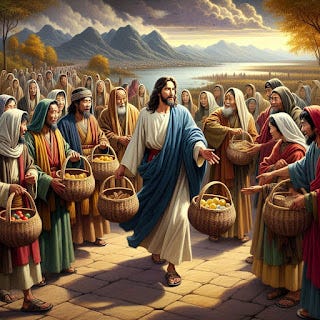
Other than the Resurrection, the feeding of the five thousand is the only story to appear in all four Gospels.
After this Jesus went to the other side of the Sea of Galilee, also called the Sea of Tiberias. A large crowd kept following him, because they saw the signs that he was doing for the sick. Jesus went up the mountain and sat down there with his disciples. Now the Passover, the festival of the Jews, was near. When he looked up and saw a large crowd coming toward him, Jesus said to Philip, "Where are we to buy bread for these people to eat?" He said this to test him, for he himself knew what he was going to do. Philip answered him, "Six months' wages would not buy enough bread for each of them to get a little." One of his disciples, Andrew, Simon Peter's brother, said to him, "There is a boy here who has five barley loaves and two fish. But what are they among so many people?" Jesus said, "Make the people sit down." Now there was a great deal of grass in the place; so they sat down, about five thousand in all. Then Jesus took the loaves, and when he had given thanks, he distributed them to those who were seated; so also the fish, as much as they wanted. When they were satisfied, he told his disciples, "Gather up the fragments left over, so that nothing may be lost." So they gathered them up, and from the fragments of the five barley loaves, left by those who had eaten, they filled twelve baskets. When the people saw the sign that he had done, they began to say, "This is indeed the prophet who is to come into the world." - John 6:1-14
So, here is a crazy question. Would Jesus have been happy about how the Gospel writers told the story?
John calls it a sign, and the others treat it as a miracle. I wonder if Jesus would have been upset with how the story was told.
What message did you give them? Just that it was a miracle? What are they supposed to do with that?
Jesus was a teacher. He had been teaching them for hours. We have no idea what the lesson was, but they kept following him, wanting more of this wisdom, this insight into the Kingdom of God here on earth.
Then, he realizes they are hungry, and he asks Philip where can we buy bread for them to eat?
There is a clue here. The Passover was near. These people were coming to Jerusalem to partake in the Passover meal with family and friends. Would they be coming without food?
They wouldn't have the meat, but they might have had the bread and honey and bitters. They would have had something with them.
I think Jesus would have wanted us to focus on what he does next. He sees what could be a problem and creates a way for everyone to work together to solve it.
Seat them, in groups of fifty, he tells the disciples. Why?
Fifty is a manageable number, and fifty people each with some food, could have enough for all, like a family meal, like Passover.
Then, he starts the ball rolling by taking a small amount of food and passing it among them.
This is like putting money in the tip jar on the bar or passing around the plate at Sunday service with a ten and a twenty already in it.
If I was sitting in a group of fifty and saw many more groups, a hundred, to be exact, I would take a little and give a lot.
I prefer to think that is the message Jesus wanted us to take away from this.
Instead, we have an amazing story of a miracle that doesn't encourage us, who may have a lot, to do anything for those who have too little.
Sharing what we have with those in need, for me, is the point of this story. And it works. In the end, there is food left over.
Now, you don't have to agree with me on this one. I am not saying Jesus didn't perform a miracle here. But I am saying, I think he would want us to walk away feeling the need to make miracles where we are.
More to come...