

Monkey See - Monkey Do

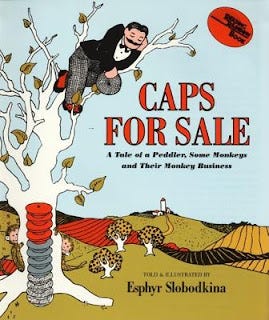
Caps for Sale
Have you heard the expression, Monkey See – Monkey Do?
It comes from a folktale that was popularized by Esphyr Slobodkina, an artist and illustrator who wrote a children's book called Caps for Sale: A Tale of a Peddler, Some Monkeys and Their Monkey Business.
In the story, a cap salesman walks through the town wearing all his caps on his head. He chants, “Caps for Sale! Fifty cents! as he goes. One day, he takes a nap under a tree, still wearing his caps, but when he awakens, a band of monkeys are sitting in the tree each with a cap on its head, leaving him with one cap on his head. The salesman waves his arms yells at them to return the caps, but they just imitate him. After repeated efforts to get them to return the caps fail, he has an idea. He removes his cap and throws it to the ground. All the monkeys do the same. The salesman then gathers up the caps, and goes on his way.
They didn't do what he told them to do; they did what he did, instead.
My mother was a life-long smoker. Between my mother's cigarettes and my father's cigars, one could always find an ashtray in our house. But when my sister and I snuck out back and lit up, we were reprimanded.
We were not to smoke. Period. No discussion.
Don't do as I do; do as I say!
Needless to say, I picked up the habit in college, when I was out of sight. What was I thinking? I knew it was bad. I hated the smell of those ashtrays filled with stale butts, and when the ashes got wet, forget about it! I had to make my own decisions, and I lived with the consequences. Whether I accepted it or not, I chose to imitate my parents.
Monkey see - Monkey do.
It took me nearly 15 years to quit for good after I started. It was not easy. It was harder for Mom. Her habit shortened her life.
Brothers and sisters, join in imitating me, and observe those who live according to the example you have in us. - Philippians 3:17
Paul understands human nature. He tells the faithful to follow his example. That was probably good advice, since they would most likely do that anyway.
Psychologists call it the chameleon effect, the unintentional mimicry of others.
I can always tell who my wife is talking to on the phone. She begins to sound like the person she is talking to, and she doesn't even realize she is doing it. I will be walking by and tell her to say hello to Nancy for me. She thinks I am clairvoyant.
So, why is Paul telling the Philippians to do what they would probably do anyway?
He knows there are others whom they encounter regularly who don't do as he does.
For many live as enemies of the cross of Christ; I have often told you of them, and now I tell you even with tears. Their end is destruction; their god is the belly; and their glory is in their shame; their minds are set on earthly things. - Philippians 3:18-19
Don't copy them! Listen, watch and do what you see that is good and just.
In today's Gospel reading, Luke tells us that Jesus ignores the warning from the Pharisees that Herod wants to kill him. Jesus tells them he has too much to do right now, over the next three days, to be bothered with Herod. Then he says something that doesn't seem to fit.
Yet today, tomorrow, and the next day I must be on my way, because it is impossible for a prophet to be killed outside of Jerusalem.' Jerusalem, Jerusalem, the city that kills the prophets and stones those who are sent to it! - Luke 13:33-34
You, people of Jerusalem, will do what you always do. You will do what your leaders do. You have seen that those who bring you messages from God, suffer. Why would they mimic the Prophets? Why would they listen to them?
There are times when I feel good about the way I live my life. I look at the lives of Paul and Jesus, Peter and the other disciples, Mary Magdalene, John the Baptist, and I think I am doing a good job following their examples. But I can be very selective in my mimicry. I may see, but don't always do.
When I am surrounded by people with strong opinions that conflict with mine, how do I behave?
Do I say what they say? Do I do what they do?
In the coming weeks, we will witness an amazing transformation in the followers of Jesus. On Palm Sunday, we will celebrate with them as Jesus returns to Jerusalem, knowing, as he said in Luke, that this is the city that kills prophets. The people will be fully supportive of this arriving king.
But then what will they do? Will they continue to follow his example, or look to their leaders and do what they do?
I need to take a close look at myself, and ask: As a Christian, how effective am I in setting an example to follow?
Do I stick with the program when the odds are against me?
Or do I change my colors and fade into the crowd?
Our Lenten preparation is a time for asking ourselves the tough question.
When you look at me, whom do you see?