

One Author

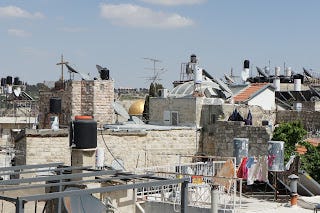
Rooftops in Jerusalem
We met, about twenty of us, at a lovely home in Rye. We greeted each other in peace and we shared blessings before splitting into three groups to talk. A few went off to pray before joining us at the table to eat and talk.
The first question was: "What does it mean for humans to bless God?"
We bless you for our creation, preservation, and all the blessings of this life. - General Thanksgiving
The question helped us focus on the idea of offering a blessing to God. We say these words in our prayers of thanksgiving, but what do we mean by them? Is it possible for man to bless God?
Last night, a small group of Christians, Jews and Muslims, together, respecting one another, shared and listened intently for the differences in our beliefs, finding instead, many similarities. We use different words, but the message is the same.
What does a blessing accomplish?
The second question brought us to a point of reflection. Is there a difference between a blessing and a prayer of thanksgiving? What do we do, how do we act, to please God?
Our focus for the evening was on the stories of Exodus taken from the scriptures of the three faiths. After dinner, we listened to three perspectives on that exodus story and back in our groups, we shared our thoughts, and asked our own questions of each other.
The idea that we are all on an exodus in this life gave us a focal point in our thoughts about being a blessing through our actions. To live as a testament to God may mean to leave our comfort zones and go out into the world, to be on an epic journey.
By the end of the evening, which seemed to come much too quickly, we all agreed on one thing. We want to meet again. Most want to learn from each other, but the real challenge is to share with those who are not in the room, those who don't hear anything in common when they hear the viewpoint of others.
Why should we have a dialogue across faiths?
It occurred to me as we shared, that there is a way to bless God. It has to do with joining as one voice.
The leader of our group asked us a question about the others, those who are not at the table, those who don't believe, or have no idea about God. How do we include them in the conversation?
That may be the answer, I thought. How much more powerful would three voices be than one? How great would it be to offer three views of God to the one who has heard or seen none?
Would it be too radical to go as one and tell people they have more than one way to see and hear God?
One of the men summed it up quite simply. One author, three works, he said.