

Redacted?

Sometimes I focus on things that aren't there.
Let me clarify that. Sometimes, when I notice something has been omitted I seek it out wondering why.
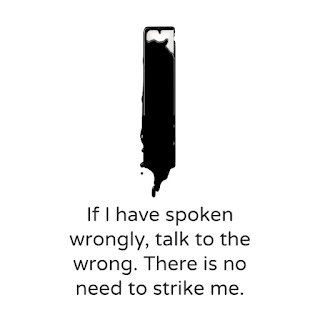
Then the high priest questioned Jesus about his disciples and about his teaching. Jesus answered, 'I have spoken openly to the world; I have always taught in synagogues and in the temple, where all the Jews come together. I have said nothing in secret. Why do you ask me? Ask those who heard what I said to them; they know what I said.' When he had said this, one of the police standing nearby struck Jesus on the face, saying, 'Is that how you answer the high priest?' Jesus answered, 'If I have spoken wrongly, testify to the wrong. But if I have spoken rightly, why do you strike me?' Then Annas sent him bound to Caiaphas the high priest. - John 18:19-24
In today's Gospel reading, the above five verses were omitted, leaving the story all about Peter's denial of Jesus. Three times he is asked if he is one of the disciples and three times he says he is not. Then the cock crows, just as Jesus foretold.
We hear that story a lot. It is part of the Passion, the long telling of the capture, trial and execution of Jesus. But what we don't often hear is what John tells us here, that Jesus had a conversation with Annas, the High Priest.
In this encounter Jesus is not the meek, silent figure we expect to see. He is not afraid to speak up and he seems to have little respect for position and title. He tells the priest to go ask the people who heard him speak if he wants to know what he said in public.
We even have an encounter with the police, and here Jesus sets an example. If I have spoken wrongly, testify to what is wrong, but if I am speaking the truth, why strike me?
The message I get from this encounter is one of strength and conviction. I believe I am right and I will stand fr what I believe. If you find it wrong, then charge me for the wrong I have committed. If not, let me go.
They don't let him go. He is hauled off and we are told in various accounts that he refused to speak.
If we had read the Gospel today without the five verses, that is what we would believe, that Jesus was humbled by authority and silenced. He wasn't at all.
If we follow this example and speak up when we believe the authority is wrong, we might not win, but we will set an example of what is right, of what rights we have.
I think this passage is worth reading and worth talking about, especially to our youth. It is clear Jesus did not respect the authority of these men, but he wasn't as disrespectful as the police officer described.
What would happen if one of our children spoke to the police the way Jesus did?
I would love to gather a group of young people together, read this passage and ask that question. Perhaps my friend Norman who works with incarcerated youth could try that and let us know what they have to say.
It might just be enlightening for all of us.
More to come...