

Righteous Humility

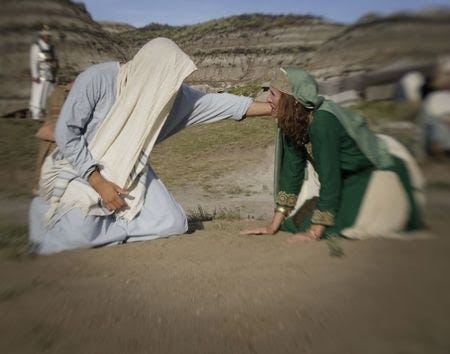
Jesus Forgives
Therefore, whoever breaks one of the least of these commandments, and teaches others to do the same, will be called least in the kingdom of heaven; but whoever does them and teaches them will be called great in the kingdom of heaven.
I don't know how it sounds to you, but being called least in the kingdom of heaven sounds pretty bad to me.
Now, I know that's my pride talking. I like to be listed among the best, not the worst. I have my sights on great.
Like one proud to show off a dazzling cloak of humility so that everyone has a chance to see it, I fall into the trap of seeking acceptance, recognition and fame.
And Jesus is giving me, us a recipe for greatness.
It just happens that recipe is itself a kind of a trap, isn't it?
What Jesus is telling his disciples, and through them, all of us, is that he understands our motivations.
He knows how to push our buttons.
Every compliment he gives in today's Gospel, he counters with a warning.
And every warning has dire consequences, but only if we are the proud, self-righteous, people he knows us to be.
Let people see what you are doing, he tells us, but is that because he wants us to be proud of what we do?
Not at all.
He could just as easily have said, "Whatever you do, people will take notice, so do good. Don't be a bad example. Don't lead people astray by your example, your teaching. Act like the role model you are."
But he doesn't stop there. Why does he want us to be a good example?
“So that they may see your good works and give glory to your Father in heaven.”
It isn't so that we get the credit.
That's tough, isn't it?
I like getting the credit. Isn't that how it has always been in everything we've ever done?
Do a good job and you will be rewarded. Give so you will receive. Do onto others the way you want them to do onto you.
Study hard and get the good grade.
Get good grades and get into college.
Lose ten pounds to be able to button your pants or your collar without turning blue in the face.
It is the way things work in a world based on reciprocity.
One hand washes the other. You scratch my back and I'll scratch yours.
But Jesus tells us to let our light shine before others.
Before others? Does he mean to let my light shine before I let anyone else's light shine?
Or is he saying something else?
To go before them like a guide for them.
Be the light others need to see the way.
OK. So, how is my light a guide for others?
I remember one winter we were vacationing in Vermont. It was one of those strange winters when one day it would be freezing in the morning and then suddenly the temperature would rise in the afternoon.
Sound familiar?
On this particular day, the snow started to melt and the frozen ground yielded a thick, pea soup like fog.
Well, we were staying at a place that didn't serve dinner, so we had to drive down into the valley to go to a restaurant, not realizing that the valley had filled up with this thick fog.
As we descended, the visibility diminished to the point where I had the window rolled down and my head out trying to see the line down the center of the road.
It was that bad.
As we crept along, I noticed two tiny red dots up ahead.
There was another car ahead of us, going even slower.
As we pulled up behind him, we slowed, slower than I had ever driven before.
The car ahead turned on its flashers and pulled over to the side of the road, letting me pass. Clearly he was more nervous than I.
He didn't want to be or couldn't be the light before me. He preferred to let me guide the way in that fog.
I would like to say that I was glad to be the beacon for him, but to be honest, I found myself getting angry.
How selfish, I thought, to make me do the work for him.
Now, we made it out of that fog without incident and he quickly sped away.
No thank you or toot of the horn or wave to acknowledge my actions.
Thanks, Buddy. You selfish and ungrateful, so-and-so.
Right there, my reaction canceled out the good of my actions. I failed the humility test.
It's not easy, is it?
Who really wants to be a leader if there is no recognition to go with the job?
It is a very strange job description that Jesus is giving us, this concept of a Servant Leader.
The light that goes before to brighten the way for someone else is difficult. It's like making your favorite meal for your family and then not getting a chance to taste it yourself.
When I was still in High School, I took a summer job as a tutor.
It was a great job because it paid a terrific hourly rate. The only problem was it was only a couple of hours a week. But I didn't mind, because I was doing something I believed was worthwhile.
The student I was given to tutor was legally blind.
Now I had encountered people with physical disabilities before.
The woman who cared for us after school until my parents came home was deaf. From her, I learned how to be self-sufficient and how to overcome obstacles, living a full life, without self-pity.
So, when I discovered that this student was not totally blind, and could do much of the work on his own, if he took his time, focused on the page with his thick glasses, and put some effort into it, I expected a lot from him. I expected him to be an example of someone who overcomes obstacles and difficulties, an inspiration.
It didn't work out that way.
He played on my sympathies.
He managed to convince me that the task of reading was too difficult for him, so being a faithful servant, I read to him.
What was I teaching him by my actions?
I was doing exactly the opposite of what Jesus was telling me. I was teaching him that it pays to play the role of the invalid. People will do things for you if you make them feel guilty for not helping. I was teaching him that it pays to break the rules.
Once I let him have control over the lessons, I was no longer helping him. And not only was he cheating the system, so was I. I was taking money under false pretenses.
Life's lessons are tough.
Today's Gospel is tough.
It challenges us to think hard about the laws we follow, about the reason we follow them, and about our motives in doing so.
Throughout Jesus' ministry, he tried to get people to understand the truth behind the laws, the purpose of them, and how to truly fulfill them.
How do we honor God? How do we serve him?
How do we set aside time for him? And for us to be with each other as brothers and sisters?
How do we treat our parents and our elders?
How do we respect the life God has given us?
How do we fulfill our pledges of trust to each other, respect and value each other?
How do we respect the accomplishments, possessions and values of others?
How do we defend and protect the integrity and honesty of those we encounter?
How do we treat each other with love. Offering a hand to serve without seeking anything in return?
I believe Jesus is telling us we can do these things. He is proof they can be done. But these are not accomplishments for which we will receive a gold ring or a certificate of achievement.
These are prerequisites. They come before, not after.
We are to fulfill them as he has. And then, only then, do we begin to live.
It is easy for us to say, the laws no longer apply to us. That is how we interpret some of Paul's teachings and that may not be the right way to look at our lives and our role on earth.
What is the point of filling the lamp with oil and lighting it, if we are going to keep it hidden?
God has given each of us talents, special skills, abilities others did not get.
What are we doing with them?
Are we enjoying them in the comfort of our homes, in our private little spaces?
Or are we using them to inspire, motivate, propel forward? Are we singing alone or as part of a choir? Are we treating our lives like a retreat, a vacation, an expedition, a journey, and not taking others along with us?
When the High Priests and Scribes saw Jesus healing on the Sabbath, telling people to pick up their mats and walk, cleansing the Temple of thieves, they saw him breaking the law.
He didn't see it that way.
So, I ask you this.
Are you a good citizen? Are you, am I being the perfect, law-abiding example that our parents hoped we would become?
And if so, are we missing something?
We don't need to break the rules, or even bend them to be a beacon for someone else. We just need to shed that cloak of righteousness and stop looking in the mirror.
As much as we might like to think this life we have been given is all about us, it isn't.
It is about Him.
Let your light shine before others, so that they may see your good works and give glory to your Father in heaven.
In the name of the Father and the Son and the Holy Spirit. Amen.
* NOTE: Sermon from the Fifth Sunday of Advent (Feb 9, 2014)
Image credit: designpics / 123RF Stock Photo