

Seeded

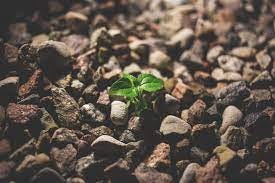
Is it possible to change what type of soil you are?
Soon afterwards he went on through cities and villages, proclaiming and bringing the good news of the kingdom of God. The twelve were with him, as well as some women who had been cured of evil spirits and infirmities: Mary, called Magdalene, from whom seven demons had gone out, and Joanna, the wife of Herod’s steward Chuza, and Susanna, and many others, who provided for them out of their resources. When a great crowd gathered and people from town after town came to him, he said in a parable: “A sower went out to sow his seed; and as he sowed, some fell on the path and was trampled on, and the birds of the air ate it up. Some fell on the rock; and as it grew up, it withered for lack of moisture. Some fell among thorns, and the thorns grew with it and choked it. Some fell into good soil, and when it grew, it produced a hundredfold.” As he said this, he called out, “Let anyone with ears to hear listen!” Then his disciples asked him what this parable meant. He said, “To you it has been given to know the secrets of the kingdom of God; but to others I speak in parables, so that ‘looking they may not perceive, and listening they may not understand.’ “Now the parable is this: The seed is the word of God. The ones on the path are those who have heard; then the devil comes and takes away the word from their hearts, so that they may not believe and be saved. The ones on the rock are those who, when they hear the word, receive it with joy. But these have no root; they believe only for a while and in a time of testing fall away. As for what fell among the thorns, these are the ones who hear; but as they go on their way, they are choked by the cares and riches and pleasures of life, and their fruit does not mature. But as for that in the good soil, these are the ones who, when they hear the word, hold it fast in an honest and good heart, and bear fruit with patient endurance. - Luke 8:1-15
On the one hand, this is a great story and Luke sets it up well.
The parable Jesus teaches is about opportunity. Anyone, regardless of the type of soil they represent, rocky, thin, thorny, or rich, they have an equal chance of getting the seeds.
The fact that many will fail at giving those seeds life is the downside, but look at how Luke sets up the telling of this parable.
He talks about the women who provide for Jesus and his entourage.
Some, like Mary, are examples of the type of soil that would have failed to produce strong plants.
So, even though the analogy Jesus uses, of people being like types of soil, Luke shows us it is possible to change what type we are.
That is key to appreciating this parable. If we thought there was no chance for some, or many, to become fruitful, we would think our faith was not all inclusive, but the richness of one's soil is our doing, not God's.
In other words, just as the builder will set a solid foundation before building a home, we become fertile by building up our faith.
We can transform ourselves from path or rocky ground by adding top soil, and we can clear away the thorns and bramble to make it easy for the seeds to take hold.
So, even though Jesus explained this parable to his disciples, I wonder if they fully grasped what it meant.
Maybe the same is true for us. Which is why we come back and revisit these parables often.
More to come...