

Sermon on MLK

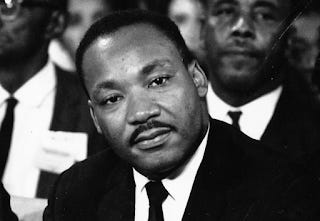
What was Martin Luther King Junior’s father’s name?
“You are Simon son of John. You are to be called Cephas” (which is translated Peter).
It may sound obvious, but if you were going to say Martin Luther King Senior, you would be wrong. At least that wasn’t his name when he was born. His name was Michael King.
His son who was born on January 15, 1929 was Michael King Jr.
Michael Senior, known as Daddy King by his friends and members of his congregation, went to Europe in 1934 for a Baptist World Alliance meeting. He traveled to Egypt and the Holy Land before going to the convention in Berlin, where he witnessed the beginning of the reign of the Nazis. Adolf Hitler had just become chancellor.
The Baptist World Fifth Congress unanimously passed a resolution at the convention.
“This Congress representing the world-wide, inter-racial fellowship of Baptists, rejoices to know that despite all differences of race, there is in Christ an all-embracing unity, so that in Him it can be claimed with deepest truth there is ‘neither Greek nor Jew, circumcision nor uncircumcision, barbarian, Scythian, bond nor free, but Christ is all in all.’
“This Congress deplores and condemns as a violation of the law of God the Heavenly Father, all racial animosity, and every form of oppression or unfair discrimination toward the Jews, toward coloured people, or toward subject races in any part of the world.
“This Congress urges the promotion of Christian teaching concerning respect for human personality regardless of race, and as the surest means of advancing the true brotherhood of all people, urges the active propagation of the Gospel of Christ throughout the World.”
King was so inspired by the Protestant Reformation Leader, Martin Luther, that he changed his name and his son’s upon his return home to Atlanta and the Ebenezer Baptist Church.
So, MLK and Simon Peter have something in common. They were both given new names before they set out on their ministries.
We know Peter’s story. He would go to the mountaintop with Jesus and witness his transformation.
In his last speech in Memphis in April of 1968, Martin would talk about going to the mountaintop and seeing the promised land.
Martin was a smart man. He skipped ninth and twelfth grades to enter Morehouse College at the age of 15. At first he didn’t have plans to become a minister like his dad. But Morehouse president Benjamin E. Mays convinced him to change his mind. He was ordained before he graduated, went on to seminary and then to graduate school at Boston University where he earned a doctorate.
In that last speech in support of the sanitation workers in Memphis he mentions the time he almost died. On September 20, 1958, he was in Harlem signing copies of his book “Stride to Freedom” when a woman asked if he was Martin Luther King. When he said yes, she said she had been looking for him for five years and then stabbed him with a letter opener.
As Martin told it in his speech, “Before I knew it I had been stabbed by this demented woman. I was rushed to Harlem Hospital. It was a dark Saturday afternoon. And that blade had gone through, and the X-rays revealed that the tip of the blade was on the edge of my aorta, the main artery. And once that's punctured, you drown in your own blood—that's the end of you. It came out in the New York Times the next morning, that if I had sneezed, I would have died.”
He received a letter from a young girl.
In his words, “And I looked at that letter, and I'll never forget it. It said simply, ‘Dear Dr. King: I am a ninth-grade student at the White Plains High School.’ She said, ‘While it should not matter, I would like to mention that I am a white girl. I read in the paper of your misfortune, and of your suffering. And I read that if you had sneezed, you would have died. And I'm simply writing you to say that I'm so happy that you didn't sneeze.’ And I want to say tonight, I want to say that I am happy that I didn't sneeze. Because if I had sneezed, I wouldn't have been around here in 1960, when students all over the South started sitting-in at lunch counters. And I knew that as they were sitting in, they were really standing up for the best in the American dream.”
King understood us as a people and he understood what motivates people in power. Money.
We remember him for his peaceful protests, for being arrested more than 30 times for standing up for what he believed was right, what he knew God envisioned for his children.
King was in Memphis to tell the striking sanitation workers they were not suffering alone. He urged everyone to join the fight, not with weapons of war but with the weapon of the pocketbook.
He talked about how much wealthier White America was than Black America (though back then he used the term Negros). This was in 1968 remember, but he said collectively, Black America’s wealth was larger than all but nine countries in the world at 30 Billion Dollars. At the time, that was more than the total exports from the US to the rest of the world.
He wanted people who were poor to see that they were not powerless. They could make an impact by choosing to boycott, to withhold their immense purchasing power.
He summed up the state of our world by talking about the parable of the Good Samaritan.
“I remember when Mrs. King and I were first in Jerusalem. We rented a car and drove from Jerusalem down to Jericho. And as soon as we got on that road, I said to my wife, ‘I can see why Jesus used this as a setting for his parable.’ It's a winding, meandering road. It's really conducive for ambushing. You start out in Jerusalem, which is about 1200 miles, or rather 1200 feet above sea level. And by the time you get down to Jericho, fifteen or twenty minutes later, you're about 2200 feet below sea level. That's a dangerous road. In the days of Jesus it came to be known as the 'Bloody Pass.’ And you know, it's possible that the priest and the Levite looked over that man on the ground and wondered if the robbers were still around. Or it's possible that they felt that the man on the ground was merely faking. And he was acting like he had been robbed and hurt, in order to seize them over there, lure them there for quick and easy seizure. And so the first question that the Levite asked was, 'If I stop to help this man, what will happen to me?’ But then the Good Samaritan came by. And he reversed the question: ‘If I do not stop to help this man, what will happen to him?’"
As we take time this week to remember Martin who was born Michael, let us remind ourselves that we all have power, individually, yes, but collectively we can be unstoppable.
If we want something bad enough, if we are willing to stand up and fight for it, if we are able to ask ourselves the question, if I don’t do something what will happen to him or her? then we can make a difference.
As Martin so famously said, “Well, I don't know what will happen now. We've got some difficult days ahead. But it doesn't matter with me now. Because I've been to the mountaintop. And I don't mind. Like anybody, I would like to live a long life. Longevity has its place. But I'm not concerned about that now. I just want to do God's will. And He's allowed me to go up to the mountain. And I've looked over. And I've seen the promised land. I may not get there with you. But I want you to know tonight, that we, as a people, will get to the promised land. And I'm happy, tonight. I'm not worried about anything. I'm not fearing any man. Mine eyes have seen the glory of the coming of the Lord.”
Amen