

Sermon: The Silencers

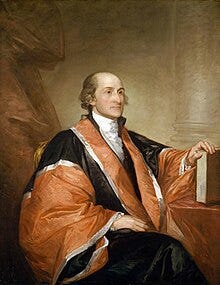
John Jay, by Gilbert Stuart, 1794
Have ever stood up to speak only to be talked down?
Have you ever been challenged and ridiculed while trying to raise a serious issue before what you thought was an attentive and potentially receptive group?
Have you ever waited patiently for your opportunity to present your views only to watch people leave one by one as you started to speak?
Jesus did.
Over and over again.
Jesus’ message was something radical, something many didn’t want to hear.
He was challenged, asked leading questions, ridiculed and mocked by those who wanted to make him look foolish.
Perhaps because they were afraid of what his message would do to their lives and livelihood.
In 1860, John Jay, an American patriot, diplomat and statesman, stood up at the 84th Diocesan Convention as a member of St. Matthew’s Church in Bedford, and he presented a resolution.
The resolution called on the bishop to write a letter to the diocese to condemn the slave trade.
This was 61 years after it had become illegal in New York State. You would think that there would be no controversy. After all, this is the North, not the South.
It had been 33 years after the last of the slaves in New York were freed, as part of a gradual approach to setting slaves free signed into law in 1799.
Female slaves born after 1799 would become free when they turned 25 and men when they turned 28, so by 1860, most people born as slaves were free.
And still NYC was an active hub for the slave trade.
Mr. JOHN JAY, Jr., offered the following resolutions which created no little stir in the Convention:
Whereas, This Convention are advised by numerous and convincing proofs that the traffic in African slaves, which the people of the United States intended should forever cease after the year 1808, hath been reestablished in the City of New-York, the seat of our Episcopate, within the limits and jurisdiction of this Diocese, in violation of the laws of God and the statutes of the Republic;
And whereas, It further appears that the said traffic hath during the last year increased so rapidly from this port that the City of New-York hath become, in the language of the London Times, "the greatest slave-trading mart in the world;"
And whereas, It would appear that the said trade so flourishes, and the laws of the Republic are thus trampled on, for the want of an enlightened and conscientious public opinion in this community with reference to the great wickedness of the said trade.
And whereas, also, It belongeth to this Council of the Church to endeavor so to act that all error, ignorance, pride and prejudice may be dissipated, and that truth and justice, religion and piety may be established among us. Therefore,
Resolved, 1. That this Convention respectfully ask the Right Reverend Bishop of the Diocese to address a pastoral letter to the people of this Diocese, in reference to the African Slave-trade as now prosecuted from the port of New-York, within the limits and jurisdiction of this Diocese, in violation of the statutes of the Republics, of the teachings of the Church, of the rights of man, and of the laws of God; to the end that such letter may be read in all the churches, and that the people may be warned in the language of the Christian Council of London in 1162, "Let no man presume from henceforth to carry on that wicked traffic by which men have hitherto been sold like brute animals."
Resolved, 2. That the Reverend Clergy of this Diocese be respectfully recommended from time to time to preach in their respective parishes against the wickedness of the Slave-trade, as now prosecuted from within this Diocese.
Resolved, 3. That the laity of the Diocese be urgently recommended to exert their influence, in all legitimate ways, to stay the further prosecution of the traffic from within the limits of the Diocese.
People in business and in the diocese were making money off the trade so there was widespread disapproval of John Jay’s resolution.
Dr. Leonard was the first to raise a point of order just as Mr. Jay was about to speak to the resolution. And when the chair, Dr. Creighton, made it clear that Mr. Jay had the floor, others rose to argue additional points of order.
Dr. Vinton obtained a hearing and stated the resolution should be tabled.
While Mr. Jay continued to insist that he should be heard, one by one, delegates raised objections to the process until a vote to table was passed.
But Jay wasn’t done. The following morning he tried again with a resolution to make the church take a stand against slavery and slave trading.
As soon as Mr. JAY had finished speaking, a motion was made to table the subject. A vote by orders was obtained and the motion was carried by an overwhelming majority, only seven clerical delegates and six lay delegations voting in the negative.
The resolution was tabled that year and it remained tabled the following year, when an attempt to resurrect it was met with a mass walkout of delegates so a quorum could not be reached.
It has remained tabled ever since. Until this convention.
The resolution was finally brought to a vote on Friday and it passed unanimously.
It took 159 years to be confident that the opposition was silenced for good, and now that the vote is over we can say that, but how many had doubts, even today?
In today’s Gospel reading, Jesus has a way of dealing with those who try to silence him.
He always seems to have an answer for the opposition and we applaud that.
We taking pride in his ability to counter punch without sounding angry or hateful, leaving the more intelligent religious leaders looking foolish.
Maybe that is not always a good thing.
We should remember that it didn’t always work.
The silencers finally hung him on a tree.
And yes, he did get the last laugh in the resurrection, but he’s Jesus and we are not.
If we are to be cross bearers ourselves, we need to remind ourselves that we will not always succeed.
Like John Jay, who, by the way had been a slave owner himself, and had the guts to go against his own interests to stand up for what he believed in, we need to start the ball rolling, even if we are not the ones who get to finish the race.
Whatever you believe in, stand up for it.
Whatever you hold dear, defend it.
Whatever you desire, go for it.
Whatever attempts to keep you from speaking your mind, disregard it.
But don’t be like those who seek to silence opposing voices.
We will never get beyond the silence if we fail to let people speak.
What was amazing about Convention this year was how many resolutions were approved unanimously or without opposition.
Does that mean we are all in agreement on everything?
No.
But instead of letting controversial issues be tabled or ignored, all were prepared to hear the message and vote on it.
It is not a surprise to me that we finally evolved to a point where we can all agree on that slavery of any kind is horrible and inhuman.
But let’s not stop there.
When an issue is presented in a way that all could find them acceptable, livable, even if the steps to follow could be difficult or financially challenging, people can find a way to agree.
Now imagine 150 years from now, when our descendants look at the issues of our day and how we fought to silence one another, what will they think about us?
Will they understand that these things were sign of the times, or will they hold us in judgment to a higher authority and fail to see how we could be so pigheaded and foolish?
We are not perfect. We don’t have all the answers. We don’t even know all the questions.
So, maybe we should table the insults and start listening to the resolutions.
More to come...