

Side by Side?

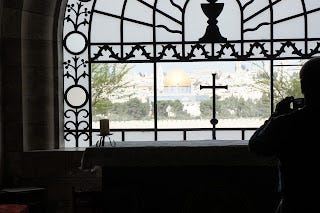
View of the Dome of the Rock
There is a bumper sticker that I see from time to time while driving and each time, I have the same reaction. Mixed.
The sticker uses symbols of belief systems and religions to spell out the word COEXIST.
My reaction is mixed because two forces work in opposition regarding the concept of peaceful coexistence in this world.
On the one hand, I want to believe that God loves all of his creation and has a special place in his heart for all of us, regardless of what we believe about him, or how we choose to believe in him.
In today's reading from John's gospel, we hear that there is a place for all, in a way.
"Do not let your hearts be troubled. Believe in God, believe also in me. In my Father's house there are many dwelling places. If it were not so, would I have told you that I go to prepare a place for you?" - John 14:1-2
But what about those who believe in God, but not in Jesus? Are some of those dwelling places for them?
If so, why bother to bring anyone to Christ?
Well, in the same chapter, John says this:
Jesus said to him, "I am the way, and the truth, and the life. No one comes to the Father except through me. - John 14:6
John doesn't leave us much wiggle room, does he? It's my way or the highway, and that doesn't sit well with a whole lot of people, including many Christians.
So, what do we do?
Well, if this was a business problems and not one involving faith, we would have the tools to analyze it and come up with options, if not solutions. So, let's give that a try.
We begin with a whole bunch of small local companies, each with its own suite of god products to help people live in peace and prosper. These god products could be fashioned out of material, like wood or stone and possessing them was a form of insurance.
For centuries, these small businesses thrived, but they never expanded beyond their local reach, unless there was a turf war. When that happened, the victor killed off the competition, or turned them into slaves, so the losing god products company went bust.
Some of these businesses grew to be pretty large, covering vast territories, but within those regions, there was no competition. They held a monopoly. Some did it by force and others did it peacefully, and as long as there were no hostile takeovers, these businesses lasted a long time.
Now, somewhere in the middle of all these other territories, one man took his nomadic family and went off following a voice, a vision. That man was Abram, and he believed all the other businesses were selling bogus products. God is not a product, he said, but a service!
Ah, what a unique approach!
It should be a lot easier to provide services to people to make their lives richer, shouldn't it?
Maybe, but the people struggled to grasp this new concept, and they kept falling back on their old brand loyalties. Generation after generation, this family business grew, but continued to struggle.
One amazing thing about it, was its ability to exist within the territories of competing companies. Even when the people were held captive, some remained loyal to this new brand. Even when the headquarters of this company was burned to the ground, it diversified into many smaller offices. Managed by a strict set of policies and rules, it survived.
One thing that kept it going was a dream for the future. One day, they believed, the one they served would send a leader to bring the company together, build a new headquarters and change the world.
After many many messengers and spokespeople representing the one they served came and went, one came among them who was not at all what they were expecting, and he changed the business model again.
This new leader had a very short reign, but made a lasting impression, reducing the many rules and policies to one, and offering to make this life as good as it can get.
They got rid of him quickly enough. Why? Because the government didn't like the way he was stirring up the people and encouraging them to help each other. But after he was gone, his managers kept the business going, spreading it all over the world, even in areas where other businesses continued to offer the old products and services.
Headquarters were being built everywhere, and some had their own management that became very aggressive, taking the competition by storm and forcing people to change. Even though the one these people served was the same as the one served by the descendants of Abram, these companies fought each other.
Oh, there were still some major companies in the East and elsewhere that kept growing without fear of competition from these newer ones. They let them battle it out on their own, until a new company came along.
This one, too, offered the same kind of service as the Abram group and its rival, but the new management brought back a set of rules to set straight all that had become corrupted.
So, here we are. That's the situation, from a business perspective.
We have competing businesses that have a common target market, and provide a similar service. Can they be content with going after the customers who have no products or services? Or do they go after each other's customers, to get them to switch loyalties?
If this was a business problem, perhaps we could be content targeting only those who have no products or services at all. We could focus on what is good and true in ours, rather than try to knock the competition, saying it is bad and evil. That would be the friendly, cooperative approach, recognizing there are many more fish in the sea.
But we are not talking about businesses. We are talking about God, and that makes the conversation so much more complicated, and personal.
For me, I believe I need to share my faith with others so that they can get to know God through me, if that is possible. At the same time, I need to be able to listen, so that I can hear God in them.
Do you think that works as a business model?