

Talented Slaves

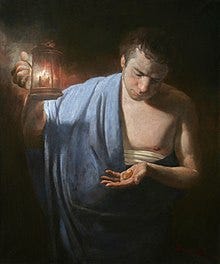
Imagine for a moment that you have slaves or servants, people who are supposed to be loyal to you and dependent upon you for their livelihood. You could trust them, right?
“For it is as if a man, going on a journey, summoned his slaves and entrusted his property to them; to one he gave five talents, to another two, to another one, to each according to his ability. Then he went away. The one who had received the five talents went off at once and traded with them, and made five more talents. In the same way, the one who had the two talents made two more talents. But the one who had received the one talent went off and dug a hole in the ground and hid his master’s money. After a long time the master of those slaves came and settled accounts with them. Then the one who had received the five talents came forward, bringing five more talents, saying, ‘Master, you handed over to me five talents; see, I have made five more talents.’ His master said to him, ‘Well done, good and trustworthy slave; you have been trustworthy in a few things, I will put you in charge of many things; enter into the joy of your master.’ And the one with the two talents also came forward, saying, ‘Master, you handed over to me two talents; see, I have made two more talents.’ His master said to him, ‘Well done, good and trustworthy slave; you have been trustworthy in a few things, I will put you in charge of many things; enter into the joy of your master.’ Then the one who had received the one talent also came forward, saying, ‘Master, I knew that you were a harsh man, reaping where you did not sow, and gathering where you did not scatter seed; so I was afraid, and I went and hid your talent in the ground. Here you have what is yours.’ But his master replied, ‘You wicked and lazy slave! You knew, did you, that I reap where I did not sow, and gather where I did not scatter? Then you ought to have invested my money with the bankers, and on my return I would have received what was my own with interest. So take the talent from him, and give it to the one with the ten talents. For to all those who have, more will be given, and they will have an abundance; but from those who have nothing, even what they have will be taken away. As for this worthless slave, throw him into the outer darkness, where there will be weeping and gnashing of teeth.’ - Matthew 25:14-30
Jesus chose slaves as the subject of his parable because they were more than employees. They were owned property.
Sounds evil and horribly insensitive today, but it causes us or the reader/listener to focus on the severity of the actions these slaves take.
As property, they wouldn't dare go against their master, though in other parables, Jesus has them do just that. So, they do what the master expects of them, all except one.
Instead of playing the game, he resists. He gives the master back what the master gave him and did nothing with it.
Today, we might make him out to be the hero of the story.
He refused to go along with what he didn't believe. If the master is evil and crooked, he would not do the master's work.
Now as a slave, his actions came with severe consequences. And so, he paid for what he did, or failed to do.
Now where are we in this story?
This is the interesting part. Depending on our world view, we can be anywhere in this story.
We can be the slave whose principles prevented him from going along with the program.
Or we can be the slaves who sought favor with the master and tried to outdo each other in the master's game.
Or we could be the master, pulling all the strings.
The parables are powerful teaching tools because they allow us to see ourselves in all the roles, giving us a chance to play the part of the ones we would normally oppose.
So, when we encounter a real life situation, we can try to see it from all perspectives.
That is, if we are open enough to do so.
More to come...