

The Human Side

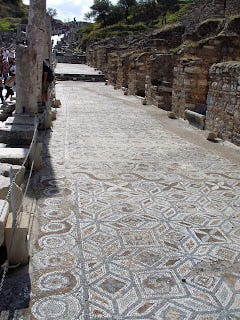
Street in Ephesus
Of all the writers of New Testament Scripture, Paul is the one I feel I know the best. His letters are personal, sharing in a way that most don't. He's human and he knows his audience, the new Church, is human, too.
His advice is harsh at times, but it is honest and to-the-point. He softens it only in the way he uses himself as an example.
Am I now seeking human approval, or God's approval? Or am I trying to please people? If I were still pleasing people, I would not be a servant of Christ. Galatians 1:10
Do you think Paul would be surprised by the way we go about our lives today?
An important question I need to continue to ask myself throughout this process is who am I trying to please? What is my motive? Am I doing this for the right reasons?
The obvious answer is I am doing this to serve Christ. That is the point, isn't it? A deacon is a servant. The first deacon, Steven, was give the role to wait on tables. So I need to humble myself and accept that or all bets are off.
The hard part comes next. If I am doing this, whatever this turns out to be, to serve Christ, how do I know I am accomplishing that goal? Paul goes on to explain his calling. He was changed by an experience he knew to be a revelation from Jesus, and from that moment on, he stopped doing what he had been doing before and started a new life.
That type of change can be frightening. I used to think that a conversion experience had to be powerful enough to stay in one's mind daily in order to keep from slipping back or doubting one's decision to change one's life. After all, look how difficult it is to make what should be simpler changes like lose weight, quit smoking, or un-clutter the garage.
Even Paul faces challenges in his commission to preach the Gospel to the gentiles. It wasn't easy for him, so I am sure he knew it wouldn't be easy for the Galatians. Like all of us, they were accustomed to following a leader, a model, an authority. They couldn't go talk to Jesus to ask what they should do, so they talked with Paul. Paul was the human side of their faith, the man in the mirror that they could compare to their own reflection, to see if they were getting close to the goal.
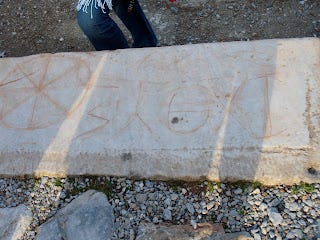
Christian Symbol
A few years back, we took a trip to Istanbul and then traveled by boat through the Aegean. One of the stops was Ephesus where Paul walked, preached and lived among the believers. There among the ruins, I could feel his presence as I imagined him walking along the stoned streets or standing in the amphitheater. One of the stones contained a carving, a circle carved to look like a sliced pie. The guide explained that it was a Christian symbol and the slices were actually Greek letters meaning, "Jesus Christ, Son of God." I realized that there were risks these early Christians took to follow their faith. Even though Paul stopped persecuting Christians, others had not.
I asked myself, what risks do I take as a Christian?
Maybe that is the whole point. If I seek approval and direction from others, will I be taking the easy road, or will I be fooling myself into thinking I have avoided risk? The human side of all this boils down to fear, doesn't it? Will I be ostracized, ridiculed, avoided if I talk about my faith? Will I offend people? Is that even a valid question?
For me, prayer helps. I know I can't do it alone, no matter what "it" is. Even when I set out to do my work, rather than God's work (as I get older the ability to tell the difference gets fuzzier), I need to feel at one with my purpose. That has become a good way for me to start my day.