

The Problem with the Givers

It's that time of year again when we shift our attention from Godly things to practical human things, like paying the utility bills and meeting the payroll.
It's Stewardship Season.
The bread of the needy is the life of the poor; whoever deprives them of it is a murderer. To take away a neighbor's living is to commit murder; to deprive an employee of wages is to shed blood. - Sirach 34:21-22
Once again, in today's readings, I focus on the wisdom of Sirach since we don't often hear about him, and I make a connection that many might find a bit disturbing.
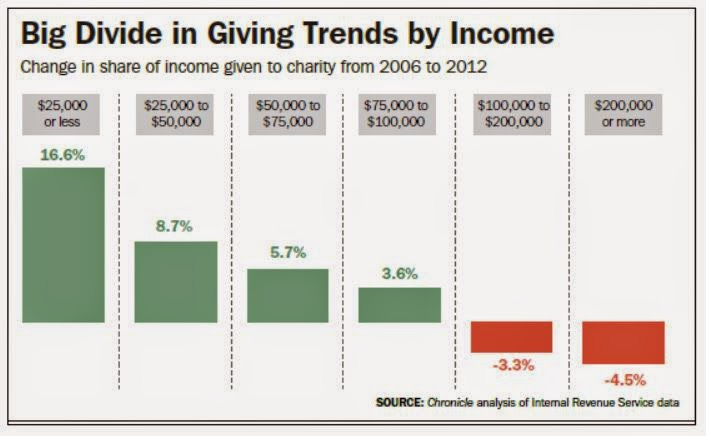
There has been a great deal of talk lately about the gap between the wealthiest and the poorest among us. For some, the need to redistribute wealth has become a campaign issue, but with all the talk of imposing taxes and other measures to satisfy what some see as a need for income equality, we are missing an important fact.
According to the IRS, those who make the least donate a larger percentage of their income to charity.
So, when we make our pleas for members of our congregation to give a little more, we can expect the ones who need help most will be the biggest givers.
What gives?
It makes sense that those who know what it is like to live day to day, just barely making ends meet will be more eager to give a larger percentage of what they have to those in need. That doesn't mean the wealthy don't give a lot of money. They do, but those most likely to dig deeper into their pockets when told of a vital need will probably be those who can't afford to give as much as they do.
That should give us pause. If we follow the lesson of Sirach, we might reconsider how we ask for pledges and donations.
But what do we do? We need to balance the budget so we can continue to serve the community.
Yes, that sounds a bit myopic to me too.
What you might notice if you visit some of the poorer congregations is that the rectors and vickers don't even ask for pledges. They know the congregation can't afford to give more than they do, so they manage without asking for more.
What that means is that they will eventually have a problem, if they don't already.
So, we have a strange situation. Asking for more money may cause a hardship for those who have the least, but not asking will cause a hardship for all in the congregation.
Redistribution will accomplish the same thing. Those who have little and get more will give away more of what they get, leaving them where they are. And those who are forced to give will find ways to avoid giving altogether, so that won't work.
What is needed is a focus on membership. We have to try to find a way to attract those who have more to offer financially to join the congregations in need.
In the end, we will be building a broader, more diverse community if we do that, and maybe, just maybe, we will all make new friends.
I am a hopeless optimist, by the way.
More to come...
Image credit - AP Story "Wealthy Have Gotten Less Generous As Poor Give More To Charity"