

The Rolling Stone

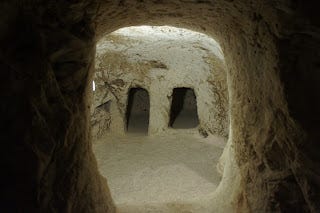
A tomb from the first century
I always had it in my mind that the tomb in which Joseph of Arimathea laid Jesus was large and spacious. The rock that was rolled across the entrance would have been as large as a man.
When we visited the Holy Lands, I was surprised to see that the entrance to one of the tombs dating back to the first century was barely wide enough for one to crawl through.
Inside, there was an open area where the body would be laid while it was prepared, wrapped in cloth with aloe and myrrh. This outer chamber could hold several bodies, either on the floor or on shelves along the walls, while the smaller, inner chambers were the final resting places for the bones, after the body decomposed.
It was customary to be buried with ones ancestors, so it was unusual for Jesus to be laid in an empty tomb in Jerusalem, rather than to be brought home to be buried in the family tomb.
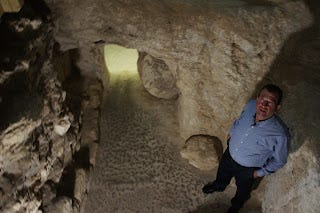
Our guide stands beside the tomb with the rolling stone visible
The actual tomb where Jesus was laid is gone. In its place is the Church of the Holy Sepulchre. While some believe that wasn't the site at all, there is uncertainty over where it was and how large it might have been. Perhaps it was larger than the one we visited, since it was owned by a wealthy man, Joseph.
But the image of the large stone I had in my head was shattered when I saw this three-foot opening. What I learned was that the stone, though small, was heavy, and to seal the tomb, one had to roll it into place, up a slight ramp or bump, to drop into a slot carved in the rock. Once in place, it would take some strength to lift it and roll it to the side.
On the first day of the week, very early in the morning, the women took the spices they had prepared and went to the tomb. They found the stone rolled away from the tomb, but when they entered, they did not find the body of the Lord Jesus. - Luke 24:1-3
Standing at the entrance to the tomb, I had a thought that seeing this small stone might make it hard for those who have doubts to believe that Jesus rose from the dead. After all, the larger the stone, the more difficult it would have been for someone to roll it away and steal the body.
That sounds silly, doesn't it?
If physical proof was a requisite for faith, who would believe?
What proof would we have if the stone was six-feet in diameter, or nine, or twelve? What I had hoped I would experience in visiting the Holy Lands was a kinship with the people and events I read about and listened to throughout my life. One of the things I worried about was coming away with present-day realities that would spoil the first century imagery I had painted in my brain. In other words, I wanted to come home with the best of both worlds, a feeling of presence and an appreciation for the way things may have been at the time of Jesus.
Seeing the tomb we visited could have been a spoiler, if I was looking for proof of anything in particular. Instead, it enriched me. I can now picture the women approaching the hewn stone and wondering why the stone was rolled away. They would have had to get down on their knees to peer in, relying on the morning light flowing in around them to let them see it was empty.
What I take back with me is this. Nothing I can say or show will, on its own, change the mind of someone who chooses not to believe. And, I may not be able to explain fully and clearly how and why I believe what I do. It is something one must experience for themselves. I know the feeling of being filled with and guided by the Holy Spirit, and I am beginning to see why God would decide to come and live among us to bring us a new value for this life we are living now.
If I can believe he became man out of love for us, I can understand that he would have to go back, leaving us his presence in the form of the Spirit that lives in us.
For me, it is like having a valuable treasure, a source of strength and power that I can tap into whenever I need it. If I fail to use it, I don't die, but I don't fully live either. I remain as I was, a lump of clay, formed and molded, filled with breath, existing for a moment in time.
But, if I choose to draw on that source of the breath that is in me, who knows how many stones I can roll aside, and what amazing discoveries I will be able to make with what I see beyond.