

Walking the Walk

What is the cost of repentance?
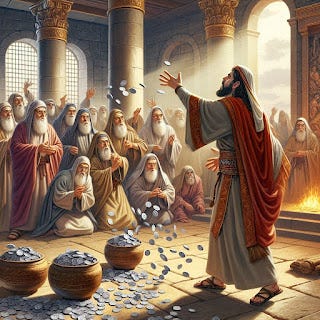
When morning came, all the chief priests and the elders of the people conferred together against Jesus in order to bring about his death. They bound him, led him away, and handed him over to Pilate the governor. When Judas, his betrayer, saw that Jesus was condemned, he repented and brought back the thirty pieces of silver to the chief priests and the elders. He said, "I have sinned by betraying innocent blood." But they said, "What is that to us? See to it yourself." Throwing down the pieces of silver in the temple, he departed; and he went and hanged himself. But the chief priests, taking the pieces of silver, said, "It is not lawful to put them into the treasury, since they are blood money." After conferring together, they used them to buy the potter's field as a place to bury foreigners. For this reason that field has been called the Field of Blood to this day. Then was fulfilled what had been spoken through the prophet Jeremiah, "And they took the thirty pieces of silver, the price of the one on whom a price had been set, on whom some of the people of Israel had set a price, and they gave them for the potter's field, as the Lord commanded me." - Matt. 27:1-10
According to Matthew, what Judas did was prophesied by Jeremiah, and that direct reference is puzzling to me. It makes me want to go back and look up the text.
But it isn't there. And that makes me feel a bit better, because if there was such a direct reference, wouldn't Judas have known about it?
His act of repentance, if we can call it that, is not based on scripture or fulfilled prophesy. It is based on his own realization of what he did, handing over his friend to be killed.
He obviously didn't expect Jesus to be condemned.
Matthew tries to show the followers that everything involved in the crucifixion of Jesus was prophesied, but does that really matter for us?
Perhaps it mattered to the people at the time. They could see that Judas had no choice. His involvement was predestined and foretold.
But that doesn't help us, does it? We need to know that our free will is at play all the time. God is not leading us into temptation but is there to guide us out if we seek Him out.
What if Judas had not killed himself? Would the others have accepted him and forgiven him?
We will never know if they would have followed Jesus' teaching. Judas should have expected them to embrace him and comfort him if he showed them he was sorry for being so foolish.
But the fact that he didn't trust them to accept him tells us something about ourselves as Christians.
We talk the talk, but don't always walk the walk.
More to come...